📢 STORAGE UNITS AVAILABLE FOR RENT 📢 Click here for more information

Written by 20 January 2026
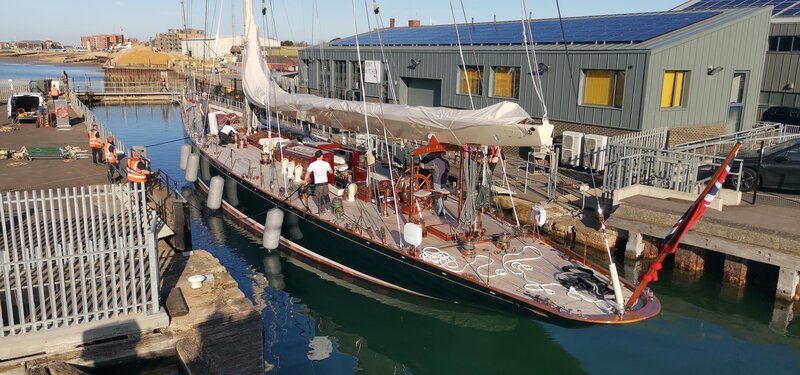
What do the late Prince Philip, seagoing vessels in need of repairs, and a nonagenarian* have in common? - They can all be linked with Shoreham Port’s Dry Dock.
Robert Penney, the chair of Shoreham Harbour Trustees, declared the Dry Dock open and operational in March 1933, nearly a century ago. The Dry Dock was created from the Port’s original entrance lock.
Although the Duke of Edinburgh didn’t cut the ribbon to open the Dry Dock, as he was born in 1921 and would have been a teenager, he could certainly have had a tour when he opened the Prince George wharf in the 1950s.
The Port’s Dry Dock was renovated in 2024 and is now open for use by any boat in need of maintenance, repairs, servicing or other attention. Shoreham’s Dry Dock also has the distinction of being the only one offering these services in the South East.
And the connection with the nonagenarian? The Dry Dock was 90 years old in 2025.
Every vessel, however indestructible and sophisticated it might seem, needs servicing to keep it thoroughly ship-shape, running safely and efficiently.
The advantage of a Dry Dock is that the hull and underside of the vessel, usually below the waterline, is exposed and accessible, making it easier and safer to carry out repairs.
Another important factor is that access also needs to be hazard-free for the team doing the work.
Shoreham’s dock is an excavated or graving dock. It has concrete walls, blocks and gates. The steel gates keep the water out while the ship is up on the blocks being repaired and serviced.
The gates can be made up of two separate hydraulically-operated pieces, or one gate on rollers which retracts into the Dry Dock walls when the gate is opened. Shoreham’s Dry Dock has two separate gates.
Other ways of carrying out repairs or maintenance to ships include:
- Floating docks, which operate at sea to salvage ships too badly damaged in an accident to make it to the nearest dry dock for repair.
- Synchrolifts, which are used to hoist up and tend to ships of appropriate weights between 800 and 25000 tons
- Slipways, for repairs to smaller boats
- Marine mobile lifts, used by yacht clubs, water parks and water training facilities.
It’s not only desirable to maintain sea-going vessels so they are in the best condition possible, the owners also have a legal obligation to keep them in good repair – rather like land vehicles needing a current MOT.
Passenger and merchant ships must undergo regular inspections by law, they are also under an obligation to do all they can to make sure their crew and anyone on board is safe.
Dry docks can also be educational: crew can use the Dry Dock to become familiar with the parts of a ship that are not visible when the vessel is in the water.
Shoreham’s Dry Dock can accommodate every type of vessel, from trawlers to square rigged sailing ships, yachts, tugs, workboats, and small ferries.
The Dry Dock can be booked by going to https://www.shoreham-port.co.uk/what-we-do/marine/dry-dock/ and you can also talk to our team of engineers if you have any queries regarding appropriate services.
* a nonagenarian is someone aged 90 or aged between 90 and 100.
