📢 STORAGE UNITS AVAILABLE FOR RENT 📢 Click here for more information

Written by 28 January 2026
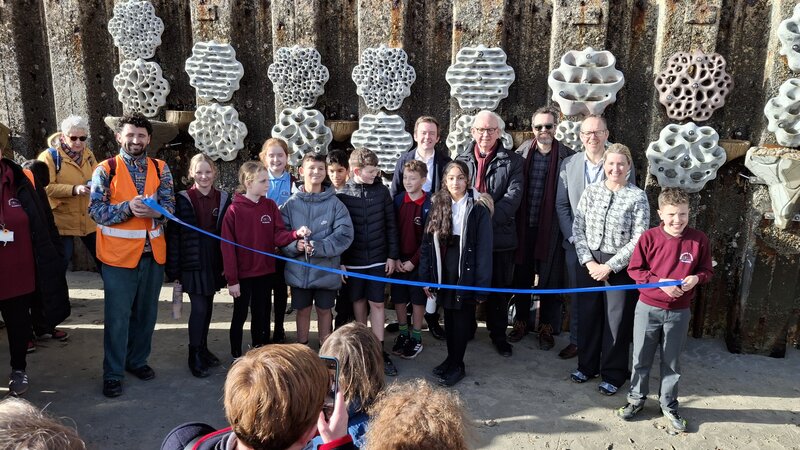
Storm Chandra retreated and the sun shone as a large crowd gathered for the opening of Southwick Reef at Shoreham Port on Wednesday.
Adults and children attended Port Kitchen’s outside area to hear the story behind the reef, which the Port and a plethora of partners have developed to protect and grow the marine environment, and increase biodiversity.
As trusted custodians of the environment, projects like Southwick Reef are also essential to build sustainability and welcome the public and the local community to the Port, said the Port’s CEO Tom Willis.
Now the UK’s biggest sea wall, the reef is crucial to encourage the marine biologists and engineers of the future, Tom added. As it progressed, its results will be studied and discussed with marine professionals nationally and internationally.
Marine biologist Thea Taylor, Managing Director of Port’s partner, the Sussex Dolphin Project, grew up on the Sussex coast and was an enthusiastic rock pooler as a child.
Thea told the audience that the sea between Brighton and Worthing is a hotspot in summer for bottlenose dolphin sightings.
The low carbon textured tiles and cubes on the sea wall and by the reef will provide habitats for sea creatures and plants which will hopefully attract more of the mammals to feed, and increase biodiversity, she said.
This is crucial in a time of habitat and biodiversity loss, she added. Already the reef is being colonized by marine animals and plant life.
Its changes will be measured and recorded as part of the Phd being undertaken at the University of Brighton, another of the project partners, along with Sussex Bay.
Taking advantage of the low tide window, the crowd walked down to Southwick beach to examine the reef and its new additions at close quarters.
As the waves boomed in the background, Port Engineering Director Brian Roussell explained how his team had attached the 100 specially-made tiles and vertipools supplied by Artecology to the sea wall. The larger cubes were placed on the beach below the rock barrier. They were made by ARC Marine.
The vertipools also included clay figures made by pupils at Eastbrook Primary Academy.
When the concrete sea wall was built in the 1950s and sea defences were added to in the 1980s, biodiversity and habitat loss were not on the radar in the same way as they are today, Brian added. Now the Port and partners were looking to the future with sustainability front and centre.
Visitors can read about the project on an information board nearby, which publicizes the Port’s Anchor Points trail.
As dogs frolicked in the shallows, partners from Adur, Worthing and Brighton and Hove councils, MP Tom Rutland, and children and teachers from Eastbrook Primary Academy combined to cut the ribbon and declare the reef open.
