📢BASE YOUR BUSINESS AT SHOREHAM PORT📢 Click here for more information about available office space to let

Written by 9 July 2026
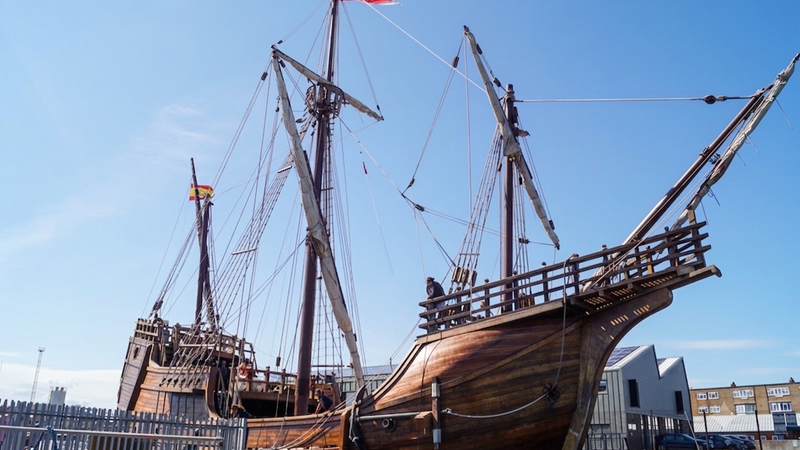
In 1492, Colombus sailed the ocean blue, says the old rhyme. The Spanish explorer could never have dreamt a 21st century replica of his vessel would be doing the same thing five centuries later.
The Nao Santa Maria docked at Shoreham Port this week, in beautiful weather that made visitors keen to feel the ocean breeze.
She was built in 14 months near Huelva, Spain, by the Nao Victoria Foundation, and set sail in 2018. Following Colombus’s route, her maiden voyage was a world tour, including America, Canada and Asia.
After Shoreham, the pine, oak and fiberglass replica, with its masts of iron, will call at Drogheda in Ireland and then sail back to the UK for a stop at Whitehaven in the north east.
The crew consists of staff and volunteers, who speak Spanish on board. Volunteer Candela Albuixe, aged 19, of Valencia, Spain, joined a month ago and is obviously loving it.
A mechanical engineer, Candela is joining the Santa Maria for a few months. “It’s a pleasure to bring a bit of living history to people in an unusual way,” she said.
The original Santa Maria would not have had the engine and iron mast, or the fibreglass shell, which are essential safety features of the 21st century version.
Colombus’s first voyage across the Atlantic was an act of great bravery by himself and his crew, without weather forecasts, radar, radio contact with land or modern satellite navigation aids.
As you walk around the 28 metre ship, with her five sails and 92 foot main mast, you feel for the medieval sailors. Their food, sponge cake or meal, was sometimes wet or rotten, and they had no privacy or space to call their own.
If they could find a spot for their blanket, they bedded down on deck once they had completed their four hour shift.
The hold was full of goods in barrels, bundles and drawers, which made the air unbreathable below, so most business took place on the overcrowded decks.
Discipline was harsh, and swearing, blasphemy, theft, playing cards, nudity or sexual activity was punished by loss of earnings and assets, whipping, exile or death.
The only crime which the powers that be turned a blind eye to was gambling. The crew bet their breeches and any funds they had on the turn of a dice.
If the sea didn’t get them, accidents or illness might. With the lack of hygiene on board, and sharing with live animals, any infection spread fast. The barbers and surgeons offering onboard treatment were not highly skilled.
The captain had his cabin, and the pilot, who was responsible for navigation, was one of the few crew members allowed on the quarter deck, essential as it gave him a clear view of the sails and the horizon.
The ship’s wheel was not invented until the 17th century, so the Santa Maria had a horizontal wooden bar connected to the rudder for steering. During storms, it would have taken a number of men to keep her on course.
With 250 square metres of sail, it’s obvious the Santa Maria was built to use wind power. To judge her speed, a sailor threw overboard a slider, or wooden float, with knotted rope attached.
Another man turned their hour glass, lasting half a minute, and counted the number of passing knots within that time to estimate her speed. Knots are still used as a measure at sea today.
Standing on the poop deck looking forward, visitors can easily imagine the thrill and the danger of those early voyages. After the 12th and 13th centuries, European traders were keen to sail to Asia and bring back spices, the gold of their day.
One small sack of pepper was worth a lifetime of an ordinary person’s wages.
Today the Nao Santa Maria is promoting the culture, heritage and tourism of Huelva in Spain. For a short time in Shoreham, a lucky few got to look through a fascinating window into the past.